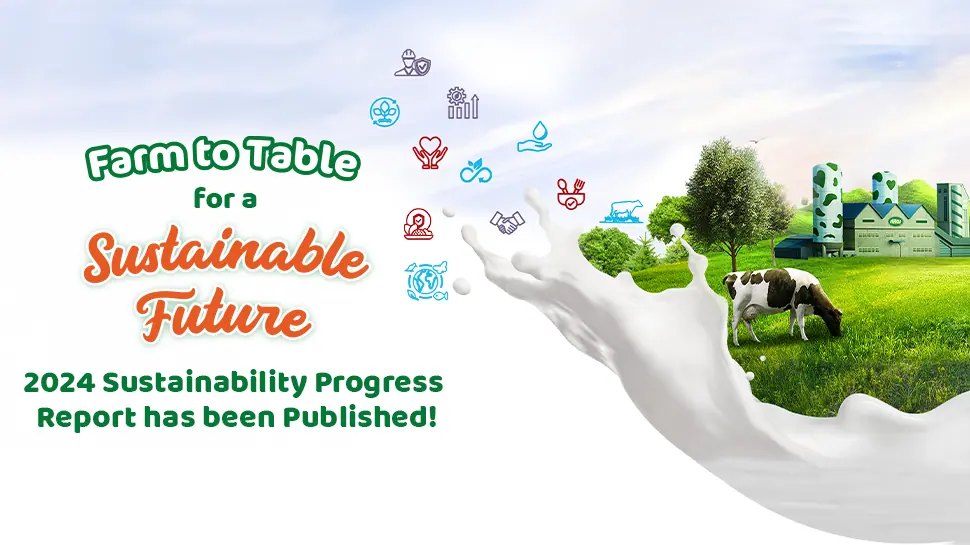
Sütaş has shared its ninth Sustainability Progress Report, outlining the activities carried out in 2024 to achieve its sustainability goals.
Meeting 92% of its electricity needs through renewable energy generated from its cows’ manure and organic waste, Sütaş continues to lead the transformation of food systems and the dairy sector through its circularity- and sustainability-driven “From Farm to Table” integrated business model. This model promotes the development of systems that are in harmony with nature, resilient to risks, and fair and inclusive for all stakeholders.
Sütaş has published its ninth Sustainability Progress Report, presenting the results of its efforts to further contribute to Environmental Sustainability,Health and Happiness of People, and Development and Prosperity of Society through its sustainability- and circularity-driven “From Farm to Table” integrated business model.
“The Climate Crisis Remained at the Top of the Global Agenda”
Commenting on the Sustainability Progress Report, Sütaş Board Member and Sustainability Committee Chair Duygu Yılmaz pointed out that global political and economic uncertainties increased throughout the year, while issues such as the climate crisis, digital transformation, circular economy, biodiversity, and inclusivity gained greater prominence on the global agenda. She emphasized that 2024 was a year marked by significant developments affecting the way companies approach sustainability and conduct business.
Yılmaz stated:
“In 2024, the record for the hottest year was broken once again, and for the first time, the increase in global temperatures exceeded 1.5°C compared to pre-industrial levels. This once again demonstrated the importance of expanding renewable energy capacity in the fight against the climate crisis.
Within the framework of the European Green Deal, discussions around the circular bioeconomy based on the sustainable production, use, and regeneration of biological resources in food systems and the dairy sector gained further momentum.
At the same time, the green and digital transformation, which has long been referred to as the ‘Twin Transition,’ evolved into a ‘Triple Transition’ through the integration of social transformation. The social dimension is now being recognized not only as an ethical responsibility but also as a strategic element for successfully implementing sustainability, encompassing fundamental principles such as social well-being, quality of life, inclusiveness, and fairness.”
“We are Leading a Transition That our Industry Needs”
Yılmaz summarized Sütaş’s sustainability approach and activities as follows:
“We are proud to be leading the sustainable transformation that our industry needs through our ‘From Farm to Table’ business model, which integrates the entire dairy value chain—from the feed consumed by our cows to the products that reach consumers’ tables. This model, built on the principles of circularity and sustainability, enables us to meet both society’s food security needs and our consumers’ expectations for food safety and reliability in the best possible way. In doing so, we contribute to individual health and happiness, social development and prosperity, and environmental sustainability.
The year 2025, in which we celebrate the 50th anniversary of our company, is especially meaningful and significant for us. Our business model, the expertise we have gained through focus, our continuously strengthening corporate structure, and our passion for spreading the goodness and abundance of milk provide a strong foundation for our sustainability vision and give us confidence for the future.
On our half-century journey, we take great pride in having built an integrated sustainability model.”
Duygu Yılmaz, Board Member and Sustainability Committee Chair of Sütaş.
“Our Renewable Energy Production Capacity Is Increasing”
Yılmaz stated that, within the scope of combating climate change, they continue their investments without interruption to increase renewable energy production capacity, and shared the results achieved through their sustainability efforts in 2024:
“As of the end of 2024, we met 92% of the electricity needs and 38% of the heat needs of our industrial facilities through renewable energy generated from our cows’ manure and organic waste.
By using organic and organomineral fertilizers obtained from the outputs of our biogas plants, we improved 117 thousand decares of land and further advanced our regenerative agriculture activities.
We are also very pleased with our work for the development of sustainable dairy farming in our country and our increasingly growing sectoral collaborations.
On the other hand, we have reached a solar energy capacity of 22.2 MWp, moving closer to our target of 25 MWp by 2025.
We have also accelerated our efforts to develop the necessary infrastructure to report Scope 3 emissions and to establish our science-based net zero targets.”
Duygu Yılmaz, Board Member and Sustainability Committee Chair of Sütaş.
“We are Planning to Establish a Sustainability School”
Duygu Yılmaz, also explained that in 2024 the Sustainability Committee of Sütaş took steps to strengthen its corporate structure in order to adapt to ongoing changes and developments in sustainability:
“In order to further embed our sustainability mindset into our corporate culture, we diversified and strengthened our sustainability training programs. While we aim to complete these trainings by the end of 2025, we also plan to establish a ‘Sustainability School’ in the coming period to support our colleagues with training aligned to their areas of expertise.”
The report also highlights the following key achievements:
- The amount of greenhouse gas emissions prevented through waste processing in biogas facilities is equivalent to 250% of the emissions generated from Sütaş’s own operations.
- Energy efficiency increased by over 7%.
- Between 2020 and the end of 2024, 1,262 tons of plastic reduction was achieved.
- The proportion of suppliers with Global Food Safety (GFS) certification reached 78%, exceeding the 2025 target.
- Improvements in route planning resulted in a 7.3% efficiency gain in raw milk logistics compared to 2023.
- Efficiency gains in finished product logistics continued in 2024, with a 2.5% improvement compared to the previous year.
"2024 Sustainability Progress Report" via the link below.