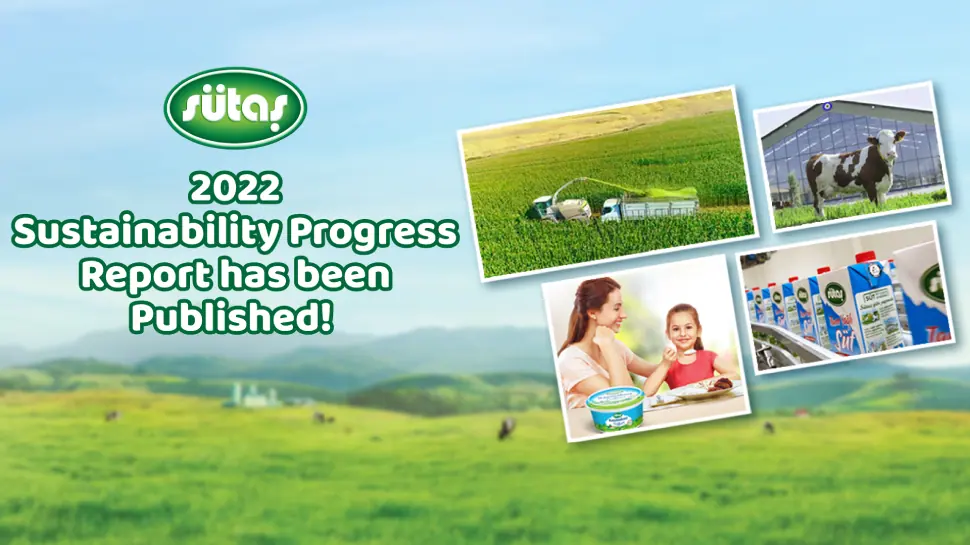
Marking World Food Day on 16 October, Sütaş released its Sustainability Progress Report. Commenting on the occasion, Duygu Yılmaz, Chair of the Sustainability Committee at Sütaş, said:
"By releasing our report on this important day, we aimed to contribute to raising awareness of the transformation of food systems based on sustainability and circularity. As our planet strives to address the challenges posed by climate change, global warming, and the rapid depletion of natural resources, we, as the food industry, have a responsibility to ensure access to healthy food for a growing global population. At Sütaş, we operate with our 'From Farm to Table' integrated business model, which places sustainability at its core and which we believe contributes to addressing these global challenges. This model also enables us to meet our consumers' expectations for natural, safe, and reliable food in the best possible way."
As the impacts of climate change become increasingly evident, the need for collective action across all sectors of society continues to grow. Sustainability, which plays a critical role in preventing future environmental challenges, has become one of the highest priorities for governments and businesses alike. In this context, the transition toward sustainable food systems is receiving greater global attention.
Marking World Food Day on 16 October, Sütaş published its 2022 Sustainability Progress Report, demonstrating how its integrated "From Farm to Table" business model, with sustainability at its core, serves as a leading example of sustainable food production.
"We Wanted to Contribute to Raising Awareness by Releasing Our Report on World Food Day"
Expressing her satisfaction in sharing the Company's sustainability performance for 2022 and the progress made toward its strategic goals for 2025, the year in which Sütaş will celebrate its 50th anniversary, Duygu Yılmaz, Chair of the Sustainability Committee at Sütaş, said:
"By releasing our report on this important day, we aimed to contribute to raising awareness of the transformation of food systems based on sustainability and circularity. As our planet strives to address the challenges posed by climate change, global warming, and the rapid depletion of natural resources, we, as the food industry, have a responsibility to ensure access to healthy food for a growing global population.
At Sütaş, we operate through our 'From Farm to Table' integrated business model, which enables us to manage the entire value chain from the feed consumed by our dairy cows to the milk and dairy products delivered to consumers' tables through full supply chain integration. We believe this model contributes to addressing these global challenges. Built on the principles of sustainability and circularity, it also enables us to meet our consumers' expectations for natural, safe, and reliable food in the best possible way."
"Climate Action and Carbon Management Remain Among Our Priorities"
Highlighting that climate action and carbon management continued to be among the Company's key priorities in 2022, Yılmaz stated:
"Through our initiatives, we achieved a 7% reduction in greenhouse gas emissions compared with the previous year, while our emissions intensity decreased by 10%. Our biogas facilities, where we process manure from our farms together with all organic waste generated at our production sites to produce electricity, steam, and hot water, remain our most effective tool for reducing our climate impact.
Through our investments to date, we have increased our electricity generation capacity across our four integrated facilities to 18.1 MWh and our thermal energy capacity to 18 MWh. We now meet 80% of the electricity demand of our production facilities through our own renewable energy generation.
As a result, we have also captured 590,000 tonnes of carbon, equivalent to 252% of the greenhouse gas emissions generated by our operations. In addition, our energy efficiency initiatives delivered 26 million kWh of energy savings between 2015 and 2022—enough to meet the annual electricity consumption of approximately 9,400 households."
Renewable Energy Portfolio Expanded Through Solar Power Investments
Yılmaz continued by highlighting the Company's renewable energy initiatives:
"In 2020, we decided to diversify our renewable energy generation and set a target of 25 MWp of installed solar power capacity. In line with this goal, we completed the installation of a 1 MWp solar power plant (SPP) at our Bingöl Integrated Facility and a 4.9 MWp SPP at our Tire Integrated Facility. Feasibility studies and technical planning for additional rooftop solar power systems at our farms and production facilities in other locations are currently underway."
Feed for Sütaş Dairy Cows Is Produced in Line with Regenerative Agriculture Principles
Emphasizing the Company's regenerative agriculture practices implemented together with its contracted farmers, Yılmaz said:
"To improve soil health in the fields where feed for our dairy cows is grown, we continue to expand the use of organic and organo-mineral fertilizers produced from the outputs of our biogas facilities. As a result, the amount of organic matter returned to our soils increased by 43% compared to 2020, reaching 43,000 tonnes in 2022.
We also continue to conduct field trials in cooperation with the Provincial Directorates of Agriculture and Forestry to evaluate the impact of organic and organo-mineral fertilizers on soil quality and agricultural productivity."
Our Integrated Facilities Contribute to the Prosperity of Their Regions
Noting that the "From Farm to Table" business model represents a Regional Development Model through its economic, social and inclusive impact, Yılmaz continued:
"Beyond environmental sustainability, our business model enables us to create social and economic value for our stakeholders. Our investments stimulate a wide range of sub-sectors across agriculture, industry and services, contributing to local economic development and enhancing the well-being of the communities where we operate.
In 2022, we sourced milk from more than 18,000 dairy farmers and enabled the contracted cultivation of forage crops on 33,200 decares of agricultural land. Through our contract farming model, we supported forage crop producers throughout the entire production process—from soil preparation and seed selection to efficient irrigation systems, the supply of organic and organo-mineral fertilizers, and harvesting.
We also continued to support our milk producers in improving the quality and productivity of their operations through training on sustainable dairy farming practices and on-site advisory and audit programmes."
Addressing the growing global focus on reducing both plastic waste and food loss, Yılmaz added:
"We believe in the power of collaboration in addressing both challenges and actively work with our stakeholders through various initiatives. By the end of 2022, our packaging lightweighting programme had enabled us to reduce plastic use by approximately 2,100 tonnes. We also succeeded in keeping our food loss below 1%."
Sütaş invites all stakeholders interested in sustainability to explore its 2022 Sustainability Progress Report, which outlines the Company's achievements and progress toward its 2025 sustainability goals across three strategic focus areas: environmental sustainability health and happiness of people, development and prosperity of society.